
How to grow onions in a raised bed: day length, spacing and harvest
To grow onions in a raised bed, plant small sets or young plants about 1 inch deep and about 4 inches apart, which is 9 to a square. Choose a type that fits your day length, with short-day onions in the South and long-day onions in the North. The planting dates below come from the BE plant library behind BE Garden Match, and at that spacing a BE Inline holds up to 144 bulb onions.
At a glance
How to plant
Sets or young plants, about 1 inch deep
Spacing
9 per square, about 4 inches apart
Day length
Short-day in the South, long-day in the North
First harvest
100 to 120 days
When to plant onions
Onions are a cool-season crop and can stand temperatures well below freezing (Texas A&M AgriLife Extension). In zones 3 to 7 they go into the bed in spring, from March in zone 7 to May in zones 3 and 4. Across the South, from zone 8 to zone 10, they go in between fall and early spring.
To grow your own plants from seed, sow them indoors about 10 weeks before the dates to set them out. The table gives both for each region.
| Region | Zones | Start seeds indoors | Set plants in the bed | First fall frost |
|---|---|---|---|---|
| East, Midwest and Plains | 3, 4 | late Feb to late Mar | May | Sep 25 |
| East, Midwest and Plains | 5 | early Feb to early Mar | late Apr to early May | Oct 8 |
| East, Midwest and Plains | 6 | early Jan to early Mar | late Mar to early May | Oct 20 |
| East, Midwest and South | 7 | late Dec to early Feb | early Mar to late Apr | Nov 3 |
| The South, Virginia's coast to north Texas | 8a | early Jul to early Aug, and early Dec to early Jan | late Sep to early Oct, again late Feb to late Mar | Nov 12 |
| The South, coastal Carolinas to central Texas | 8b | early Aug to early Sep, and late Nov to early Jan | late Oct to early Nov, again late Jan to early Mar | Nov 28 |
| Gulf Coast and North Florida | 9a | late Sep to late Nov | early Dec to late Feb | Dec 8 |
| Central Florida | 9b | late Jul to late Sep | early Oct to late Dec | Rare |
| South Florida and the Keys | 10, 11 | late Jul to late Aug | Oct | Rare |
| South Texas, Lower Rio Grande Valley | 9b, 10 | late Jul to late Sep | early Oct to late Nov | Rare |
| Mountain West, high elevations | 3 to 5 | late Feb to early Apr | early May to early Jun, again early Aug | Sep 12 |
| Mountain West valleys and high desert: Denver, Salt Lake City, Boise, Albuquerque, Reno | 6, 7 | late Jan to early Feb, and late May to early Jun | Apr, again early Aug | Oct 12 |
| Mid desert: Tucson, Las Vegas, St. George | 8, 9 | late Aug to late Oct | early Nov to early Mar | Nov 28 |
| Low desert: Phoenix, Yuma, Palm Springs | 9b, 10 | late Jun to late Aug | early Sep to early Feb | Dec 12 |
| Pacific Northwest, west of the Cascades | 8, 9 | late Dec to late Feb | early Mar to late May | Nov 12 |
| California inland valleys | 9 | late Nov to early Jan | early Feb to late Mar | Dec 5 |
| California north coast and Bay Area | 9b, 10 | late May to late Jul, and late Oct to late Dec | early Aug to late Sep, again early Jan to late Mar | Dec 15 |
| California south coast: Los Angeles, San Diego, Santa Barbara | 10, 11 | late Jul to late Sep | early Oct to early Mar | Rare |
In the table, early is the 1st to the 15th of the month and late is the 16th to the end. Single regions have their own month by month lists, such as the zone 9b planting schedule for Central Florida and the South Texas planting schedule.
Short-day or long-day onions?
Onions start to form bulbs once the days reach a certain length, and each type needs a different length (Illinois Extension). Grown too far north, short-day onions start their bulbs too soon and stay small (Nebraska Extension). Long-day onions may not get the signal to form bulbs in the Deep South (Illinois Extension).
| Type | Forms bulbs at | Where it fits | Source |
|---|---|---|---|
| Short-day | 11 to 12 hours of daylight | The South | Texas A&M, Illinois |
| Intermediate-day | 12 to 13 hours of daylight | In between, such as Tennessee | Texas A&M, Tennessee |
| Long-day | 14 to 16 hours of daylight | The North | Texas A&M, Illinois |
Short-day onions are usually grown south of 35 degrees latitude, and farther north they can form bulbs too early (UT Extension). In Texas, the 1015Y sweet onion is named for October 15, the date its seed should be planted (Texas A&M AgriLife Today).
Onion sets or onion plants?
Sets are small, partly grown onion bulbs from the season before (University of Kentucky Extension). Sort them by size before planting. Sets smaller than a dime make good dry bulbs and usually do not bolt, while bigger sets are better pulled young as green onions (Illinois Extension).
Young onion plants, sold in bundles, are the most reliable way to grow large dry onions (Illinois Extension). BE Garden Match plans bulb onions as young plants. Seed sown straight into the bed goes 1/4 inch deep (Texas A&M AgriLife Extension).

How deep and how far apart to plant onions
Plant small sets about 1 inch deep and young plants 1 to 1 1/2 inches deep (Illinois Extension).
BE Garden Match plants bulb onions 9 to a square, about 4 inches apart each way, with the outer row 2 inches in from the wall. Set closer than 4 to 5 inches, onions make smaller bulbs (Illinois Extension).
| Type | Room per plant | Inline (16 squares) | Loam (26 squares) | Tiller (26 squares) | Union (28 squares) |
|---|---|---|---|---|---|
| Onion, bulb | 9 per square | 144 | 234 | 234 | 252 |
For one bed, BE Garden Match starts from 54 bulb onions, or six squares. The square foot gardening chart has the counts for other crops.
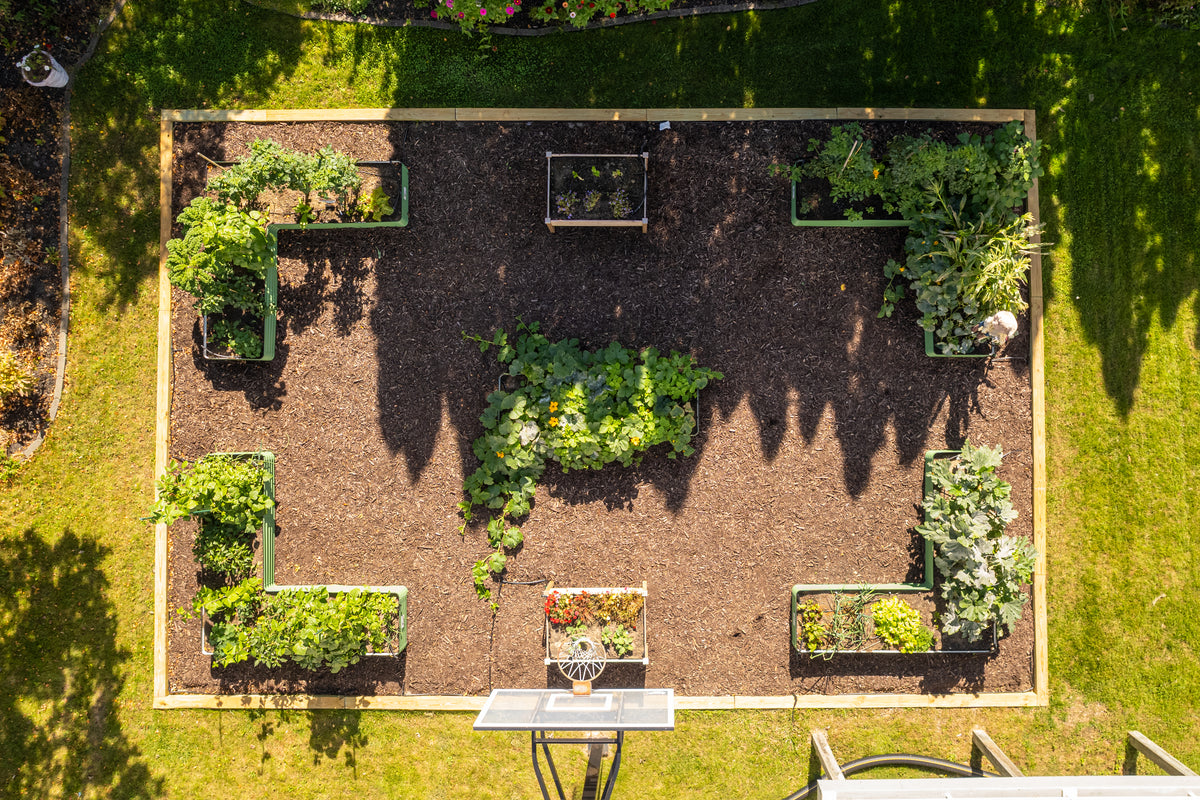
Plan your onions for the season
Pick your region in BE Garden Match and it lays out your beds square by square, sets onions beside carrots and gives you the dates to plant them. It also totals the soil for each bed and can email your plan with planting reminders.
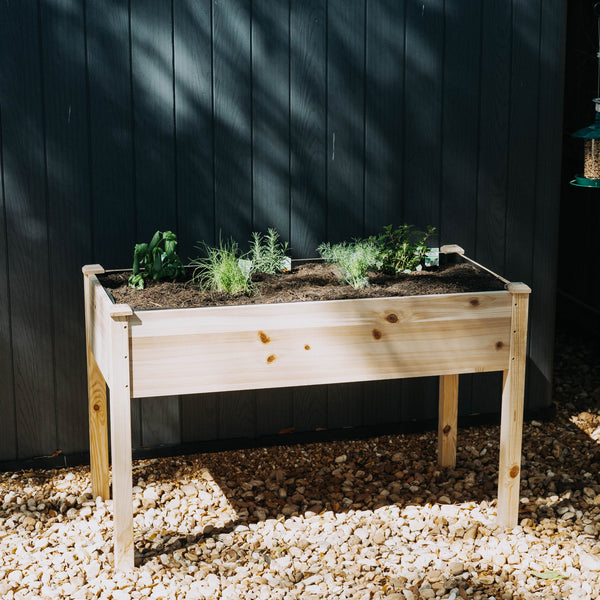
Shown: BE raised garden beds.
How often should you water onions?
In spring, watering once a week is usually enough. Water more in dry, windy weather, and water slowly so it soaks in deep (Texas A&M AgriLife Extension).
Onion roots are shallow, and onions compete poorly with weeds (Illinois Extension). Pull weeds by hand while they are small. If you use a hoe, do not chop deep, since it can cut the onion roots. When the plants have 5 to 6 leaves, scatter a little fertilizer between the rows and water it in (Texas A&M AgriLife Extension).
Why is my onion bolting?
A bolting onion sends up a flower stalk. Sets can bolt if they are left to grow, and a hard cold spell early in the season can also make them flower (Illinois Extension).
Pull bolted onions and use them right away, since they do not store well. Starting with sets smaller than a dime helps, because those usually do not bolt.
What to plant with onions
BE Garden Match plants onions beside carrots. Give them full sun, since onions handle little shade.
Onions, garlic, leeks, shallots and chives are one plant family and share soil diseases. The planner keeps them together in one bed, then moves them to a different bed for the next 3 to 4 years.
When to harvest and cure onions
Harvest bulb onions when the tops begin to fall over (Texas A&M AgriLife Extension). Let the tops fall on their own, since breaking them early gives smaller bulbs that store poorly (Illinois Extension).
- Pull the onions in the morning and leave them in the garden to dry until late afternoon. On a hot, sunny day, move them into the shade so they do not sunburn.
- Cure them under a dry roof for 2 to 3 weeks, on slats or screens or hung in small bunches, with air moving all around them.
- Cut the tops back to 1 1/2 to 2 inches, and leave the dry outer skins on.
- Store them cool and dry with good air flow. At 50 to 60°F they keep for months.
Keep bruised or cut bulbs, and any with green tops or thick necks, out of storage (Illinois Extension).
Onions need little room, so a few squares fit beside your carrots. Lay them out with the rest of your garden in BE Garden Match, or read the guides to growing potatoes, carrots and lettuce.
Seasonal tips for your zone
Get a short email when it is time to start seeds, plant and harvest where you live, with what works best in your zone.
Thanks, you are on the list for seasonal tips for your zone.
Unsubscribe anytime.
You may also like
Sources
- Texas A&M AgriLife Extension, Onions
- University of Illinois Extension, Onion
- Nebraska Extension in Lancaster County, Onions: Long Day, Short Day or Neutral?
- University of Tennessee Extension, Onions, Leeks and Shallots for the Tennessee Vegetable Garden
- University of Kentucky Cooperative Extension, Onions, Growing Your Own series
- Texas A&M AgriLife Today, Texas Super Sweet Onion named latest Texas Superstar
- BE plant library, version 2.11, and the BE Garden Match planner, version 1.8.0: planting dates, spacing and bed counts