
How to grow carrots in a raised bed: when to plant, spacing and harvest
To grow carrots in a raised bed, plant the seed straight into the bed in spring, from March in zone 7 to May in zones 3 and 4, and again in late summer where falls are long. In Florida, carrots go in through fall and winter, and in South Texas and the low desert from fall through December. The planting dates and the 16 carrots a square below come from the BE plant library behind BE Garden Match. At that spacing a BE Inline holds up to 256 carrots.
At a glance
How to plant
Seed straight into the bed, 1/8 inch deep
Spacing
16 per square, about 3 inches apart
Sprouting
Up to 3 weeks
First harvest
65 to 75 days
When to plant carrots
Carrots are a cool-season crop. They grow best when the average temperature runs 60 to 65°F, and the seed sprouts best in soil of 55 to 75°F (Clemson Cooperative Extension). That is why the hot middle of summer is left out of most rows below.
| Region | Zones | Sow seed in the bed | First fall frost |
|---|---|---|---|
| East, Midwest and Plains | 3, 4 | early May to early Jun, again early Jul | Sep 25 |
| East, Midwest and Plains | 5 | late Apr to early Jul | Oct 8 |
| East, Midwest and Plains | 6 | early Apr to late Jul | Oct 20 |
| East, Midwest and South | 7 | early Mar to early May, again early Jul to early Aug | Nov 3 |
| The South, Virginia's coast to north Texas | 8a | late Feb to late Mar, again early Aug to early Sep | Nov 12 |
| The South, coastal Carolinas to central Texas | 8b | early Feb to early Mar, again late Aug to early Sep | Nov 28 |
| Gulf Coast and North Florida | 9a | late Jan to late Feb, again early Sep to late Dec | Dec 8 |
| Central Florida | 9b | early Aug to late Feb | Rare |
| South Florida and the Keys | 10, 11 | early Sep to late Mar | Rare |
| South Texas, Lower Rio Grande Valley | 9b, 10 | early Oct to late Dec | Rare |
| Mountain West, high elevations | 3 to 5 | May | Sep 12 |
| Mountain West valleys and high desert: Denver, Salt Lake City, Boise, Albuquerque, Reno | 6, 7 | late Mar to early May | Oct 12 |
| Mid desert: Tucson, Las Vegas, St. George | 8, 9 | late Aug to early Mar | Nov 28 |
| Low desert: Phoenix, Yuma, Palm Springs | 9b, 10 | early Sep to late Dec | Dec 12 |
| Pacific Northwest, west of the Cascades | 8, 9 | early Mar to early Jul | Nov 12 |
| California inland valleys | 9 | early Feb to late Apr, again early Aug to late Sep | Dec 5 |
| California north coast and Bay Area | 9b, 10 | early Feb to late Aug | Dec 15 |
| California south coast: Los Angeles, San Diego, Santa Barbara | 10, 11 | early Jan to late Sep | Rare |
Early means the 1st to the 15th of the month, and late means the 16th on. For a steady supply, make two or three plantings three weeks apart (University of Minnesota Extension). Each region's full month by month list is in its planting schedule, starting with the zone 9b planting schedule for Central Florida.
How deep to plant carrot seeds
Plant carrot seed shallow. Clemson covers it about 1/8 inch deep with vermiculite, potting soil or sawdust.
Then wait. Carrot seed can take as long as three weeks to come up. A light spray of water on the surface makes it easier for the seedlings to push through (University of Minnesota Extension).
How far apart to plant carrots
Sow the seed thinly in rows, then thin the seedlings. Clemson thins carrots to 2 to 3 inches apart when they are 1 to 2 inches tall. Minnesota leaves them 2 to 4 inches apart.
BE Garden Match plans eight rows across the width of a BE bed, about 3.75 inches apart, with a carrot about every 3 inches along each row. That works out to 16 to a square, the same count as in square foot gardening.
| Type | Room per plant | Inline (16 squares) | Loam (26 squares) | Tiller (26 squares) | Union (28 squares) |
|---|---|---|---|---|---|
| Carrot | 16 per square | 256 | 416 | 416 | 448 |
Most households need far fewer. The amount BE Garden Match starts from is 64 carrots, or four squares.

Plan your carrots for the season
BE Garden Match lays out your beds square by square, puts carrots side by side with bulb onions and gives you planting dates for your region. It also totals the soil for each bed and can email your plan with planting reminders.
Why are my carrots forked or crooked?
Forked or split roots come from rocky, heavy or compacted soil (University of Minnesota Extension). In heavy clay, roots grow poorly and come out forked or misshaped (Clemson).
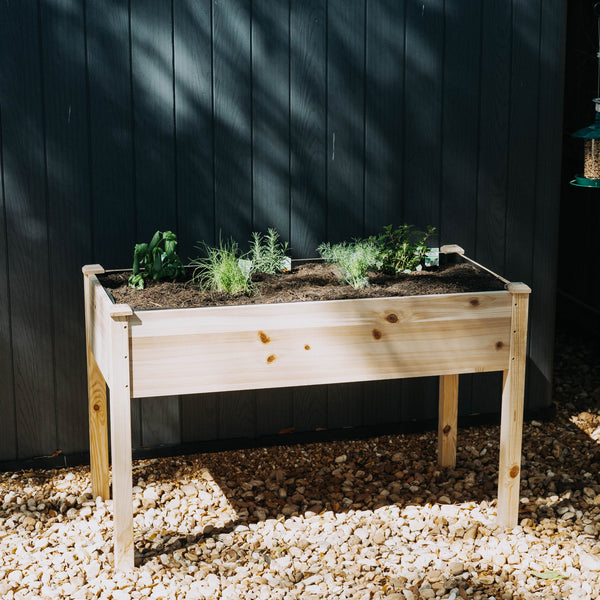
A raised bed solves most of this, and the University of Florida suggests growing carrots in one for the best results (UF/IFAS Extension). A BE bed is 18 inches deep, so even long types have loose soil all the way down. Fill it to the rim, since the soil settles.
How much soil a raised bed needs has the amounts for each bed. Lime the soil to a pH of 6.0 to 6.5 if a soil test shows it is lower (Clemson).
How often to water carrots
Give the bed about an inch of water a week when rain falls short. That inch soaks heavy clay about 6 inches deep and sandy soil about 10 inches deep (University of Minnesota Extension).
Keep it even. An uneven water supply leads to cracked roots, a strong flavor and coarse, woody carrots (Clemson).
What to plant with carrots
Sow radishes in the carrot row. Their seed comes up fast and their leaves mark the carrot row while the carrots are still sprouting (University of Minnesota Extension). The radishes are ready in about three to four weeks (Clemson), long before the carrots need the room.
Keep sunflowers in another bed, since they grow tall and thirsty and would shade the carrots. Carrots, celery, parsley and parsnips are in one family, so move that group to a new spot for three to four years after a crop (Iowa State University Extension).
Carrot pests and diseases
| Problem | What it is | Source |
|---|---|---|
| Aster yellows | A disease spread by leafhoppers, small insects that feed on plant juices | University of Minnesota |
| Parsleyworms | Larvae that feed on the leaves, though the damage is rarely severe | Clemson |
| Alternaria blight | A disease that causes leaf spots | Clemson |
| Root-knot nematodes | Pests in the soil that attack the roots | Clemson |
When to harvest carrots
Carrots are ready about 65 to 75 days after planting (Clemson). You can pull them as soon as they reach a size you can use (University of Minnesota Extension). Do not leave them long in hot weather, because roots left in the heat near maturity turn strong and fibrous (Clemson).
To store them, cut off the tops and keep the roots cold and damp, at about 33°F with high humidity. Stored that way they last four to six months (Clemson). For carrots you will eat soon, the refrigerator is fine.

Carrots fit in small gaps between bigger crops. Lay them out with the rest of your garden in BE Garden Match, or read how deep a raised bed should be and raised bed garden layout. The guides on how to grow tomatoes and how to grow lettuce cover two more crops for the same garden, and how to grow onions covers a crop BE Garden Match plants beside carrots.
Seasonal tips for your zone
Get a short email when it is time to start seeds, plant and harvest where you live, with what works best in your zone.
Thanks, you are on the list for seasonal tips for your zone.
Unsubscribe anytime.
You may also like
Sources
- Clemson Cooperative Extension, Home and Garden Information Center, Carrot, Beet, Radish & Parsnip
- University of Minnesota Extension, Growing carrots and parsnips in home gardens
- UF/IFAS Extension, SP 103, Florida Vegetable Gardening Guide
- Iowa State University Extension and Outreach, Crop rotation in the vegetable garden
- BE plant library, version 2.10, and the BE Garden Match planner, version 1.7.0: planting dates, spacing and bed counts