
How much soil do I need for a raised bed?
To find how much soil a raised bed needs, multiply its length by its width by the depth of soil, all in feet. A 4 x 8 foot bed filled 12 inches deep takes 32 cubic feet, which is about 1.2 cubic yards or 16 bags of the 2 cubic foot size. A BE Inline, our 8-foot bed, takes 31.4 cubic feet filled to the rim, and BE Garden Match adds up the soil for any garden you lay out in it. Filling the bottom half with branches, twigs and leaves cuts the soil in half, and the steps are below.
How do I calculate soil for a raised bed?
Length x width x depth, with all three in feet, gives cubic feet (Iowa State University Extension). A depth in inches is divided by 12 first: 18 inches is 1.5 feet. For cubic yards, the unit bulk soil is sold in, divide the cubic feet by 27.
A bed that is not a rectangle works the same way from its planting area: square feet times depth in feet. The L, T and U-shaped BE beds below were figured that way.
How much soil for a 4x8 raised bed?
A 4 x 8 bed takes 32 cubic feet at 12 inches deep. Other depths and sizes:
| Bed | Soil depth | Cubic feet | Cubic yards | Bags of 2 cu ft |
|---|---|---|---|---|
| 4 x 8 ft | 6 in | 16 | 0.6 | 8 |
| 4 x 8 ft | 12 in | 32 | 1.2 | 16 |
| 4 x 8 ft | 18 in | 48 | 1.8 | 24 |
| 4 x 4 ft | 12 in | 16 | 0.6 | 8 |
| 2 x 8 ft | 12 in | 16 | 0.6 | 8 |
| 3 x 6 ft | 12 in | 18 | 0.7 | 9 |
| 2 x 4 ft | 12 in | 8 | 0.3 | 4 |
How much soil does each BE bed need?
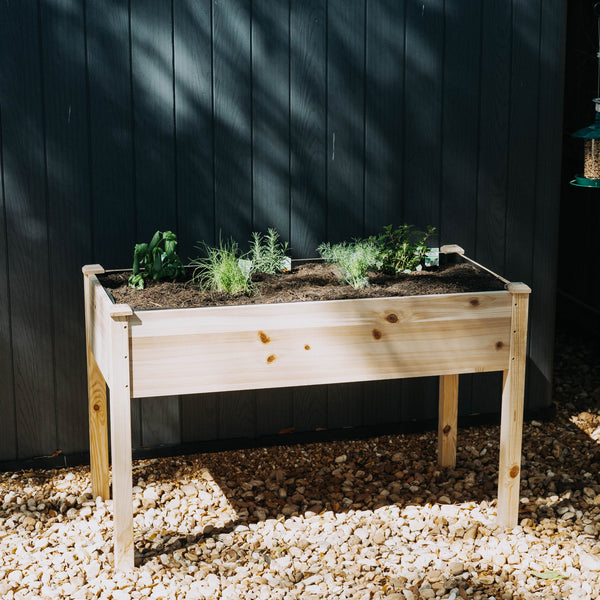
BE beds are 18 inches tall, and we fill ours to the rim because the soil settles.
| Bed | Shape | Size | Planting area | Soil | Cubic yards | Bags of 2 cu ft |
|---|---|---|---|---|---|---|
| Inline | Straight | 98 x 31 in | 20.9 sq ft | 31.4 cu ft | 1.2 | 16 |
| Loam | L | 98 x 98 in | 35.2 sq ft | 52.8 cu ft | 2.0 | 27 |
| Tiller | T | 98 x 91 in | 33.7 sq ft | 50.6 cu ft | 1.9 | 26 |
| Union | U | 98 x 68 in | 36.7 sq ft | 55.1 cu ft | 2.0 | 28 |

Planting area also sets how many plants a bed holds, which is the subject of 1x1 planting. Whether 18 inches suits a crop is in how deep a raised garden bed should be.
For a whole garden, add up the beds, or lay the garden out in BE Garden Match, which totals the soil for its beds in cubic feet, cubic yards and bags. How to lay out a raised bed garden walks through the planner.
| Garden | Beds | Soil | Cubic yards | Bags of 2 cu ft |
|---|---|---|---|---|
| The Patch | 2 Inline | 62.7 cu ft | 2.3 | 32 |
| The Alcove | 2 Loam | 105.6 cu ft | 3.9 | 53 |
| The Avenue | 1 Tiller, 2 Inline | 113.3 cu ft | 4.2 | 57 |
| The Haven | 2 Loam, 1 Union | 160.7 cu ft | 6.0 | 81 |
| The Homestead | 4 Loam, 1 Inline | 242.6 cu ft | 9.0 | 122 |
| The Bounty | 4 Loam, 2 Tiller, 2 Union, 1 Inline | 453.8 cu ft | 16.8 | 227 |
Let BE Garden Match total the soil
BE Garden Match totals the soil for each bed in your plan, so you know how much to order before you fill anything. It lays out your beds square by square, gives you planting dates for your region and can email your plan with planting reminders.
How many bags of soil do I need?
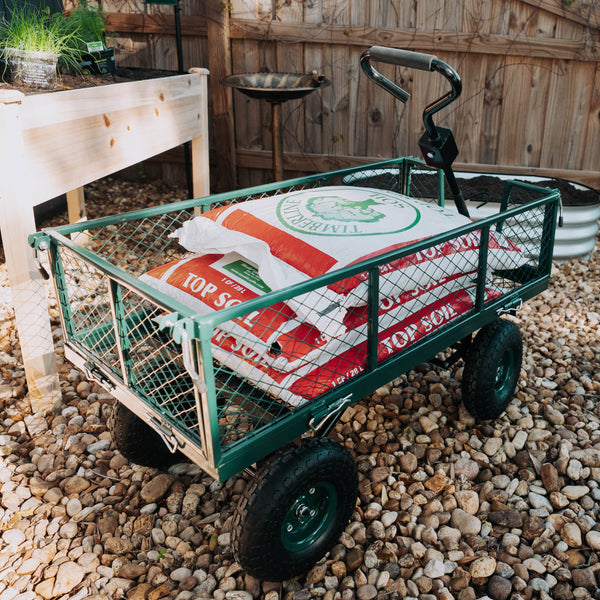
Divide the cubic feet by the size printed on the bag and round up. A 4 x 8 bed filled 12 inches deep takes 16 bags of 2 cubic feet, and so does a BE Inline filled to the rim. Topsoil bought by the cubic yard is generally much cheaper than bags (University of Minnesota Extension), so from two beds up a delivery is worth pricing.
How to fill a raised bed for less with branches, twigs and leaves
A bed does not have to be all soil. In a bed at least 17 inches tall, the bottom half can be logs, branches, twigs and leaves, with soil mix in the top half (Oklahoma State University Extension). BE beds are 18 inches tall, so that is 9 inches of each, and it cuts the soil to buy in half.
| Bed | All soil | Soil with the bottom half filled | Bags of 2 cu ft |
|---|---|---|---|
| Inline | 31.4 cu ft | 15.7 cu ft | 8 in place of 16 |
| Loam | 52.8 cu ft | 26.4 cu ft | 14 in place of 27 |
| Tiller | 50.6 cu ft | 25.3 cu ft | 13 in place of 26 |
| Union | 55.1 cu ft | 27.6 cu ft | 14 in place of 28 |
How to layer it:
- Put the biggest pieces in first: logs and thick branches.
- Add smaller branches, then twigs.
- Pack the gaps with leaves, grass clippings or straw.
- Water each layer and press it down.
- Fill the top half with soil mix, up to the rim.
What it does for the garden:
- Half the soil to buy and carry.
- Branches and leaves from the yard get used.
- Rotting wood holds water and gives it back to the soil in dry spells (Clemson Cooperative Extension).
- Leaves and grass clippings add nutrients and loosen the soil as they break down (Clemson).
Leave out black walnut, cedar, and treated or painted wood (Oklahoma State), and any wood or leaves from diseased plants (Clemson). The fill sinks as it rots, so add compost before each planting season. Fresh wood can also tie up nitrogen for the first seasons. Growing beans or peas there, or adding a nitrogen fertilizer, makes up for it (Oklahoma State).
What soil mix goes in a raised bed?
A blend of topsoil and compost. Three extension services give these ratios:
| Source | Topsoil to compost |
|---|---|
| University of Minnesota Extension | 2 to 1, up to equal parts |
| Iowa State University Extension | About 70% to 30% |
| University of Maryland Extension, on compacted or clay ground | 2 to 1 or equal parts |
For one Inline filled with soil alone, two parts topsoil to one part compost comes to about 21 cubic feet of topsoil and 10.5 of compost.

Loam or sandy loam is the topsoil to look for, and bags labeled raised bed mix also work. Potting soil is not suited to a raised bed because it dries out too quickly, and too much compost causes problems with holding water (all from University of Minnesota Extension).
Buying in bulk, ask the dealer for soil test results and where the soil came from. Have the soil tested by a lab before planting and again a year after filling, aiming for a pH of 6.2 to 6.8 (both from University of Maryland Extension; Iowa State aims for about 6.0 to 6.5).
Settling and topping up
Soil in a new bed often settles (Iowa State), and a bed built in fall or early winter will have settled by spring (University of Delaware Cooperative Extension). That is why we fill ours to the rim.
When the whole bed is soil, add the mix a few inches at a time and blend the first layers into the ground underneath, so the bed and the soil below do not stay as two separate layers (Iowa State). Later, top it up. Oklahoma State University Extension adds a two-inch layer of compost or other organic material every spring and fall, because heat breaks organic matter down quickly there.
What goes in the bottom of a raised garden bed?
Branches, twigs and leaves, as above, or nothing at all. Most beds need no barrier underneath, and one is likely to stunt root growth (University of Minnesota Extension). BE beds are open to the ground so deep roots carry on into the soil below. The exceptions are hardware cloth where mice or chipmunks are a problem, and a permeable liner when a bed sits on a patio.
Lay out your beds in BE Garden Match and it totals the soil for you.
Seasonal tips for your zone
Get a short email when it is time to start seeds, plant and harvest where you live, with what works best in your zone.
Thanks, you are on the list for seasonal tips for your zone.
Unsubscribe anytime.
You may also like
Sources
- Iowa State University Extension and Outreach, Creating Raised Bed Planters, reviewed October 2026
- University of Minnesota Extension, Raised bed gardens, reviewed 2026
- University of Maryland Extension, Filling raised beds, 2019
- Oklahoma State University Extension, Raised Bed Gardening
- University of Delaware Cooperative Extension, Raised Bed Gardening, October 2024
- BE Green Living, BE Garden Match planner data: planting area for each bed and garden, November 2026
- Clemson Cooperative Extension, Home and Garden Information Center, Hügelkultur Gardening, February 2025
- Oklahoma State University Extension, Sustainable Landscapes: Creating a Hügelkultur for Gardening with Stormwater Management Benefits