
How deep should a raised garden bed be?
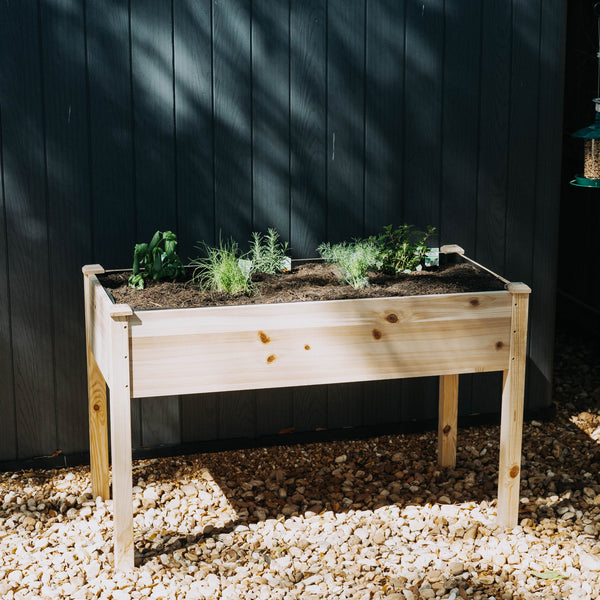
A raised garden bed on open ground needs soil 6 to 12 inches deep for most vegetables, because their roots carry on into the ground underneath. A bed on a patio or another hard surface has to hold every root itself: at least 8 inches for leafy greens, beans and cucumbers, and 12 to 24 inches for peppers, tomatoes and squash. Every BE raised bed is 18 inches tall and open to the ground.
How deep should a raised bed be for vegetables?
A framed bed should stand at least 6 to 12 inches high, which fits the roots of most vegetables (Utah State University Extension). A bed shallower than 12 inches should have no bottom, so the roots can reach the soil below. UMass Extension suggests a frame 12 to 16 inches high.
When a bed sits on the ground, the roots grow through its soil and into the soil beneath (University of Maryland Extension). An open bottom matters as much as the height of the wall.
How deep for tomatoes, potatoes, carrots, garlic and strawberries?
It depends on how deep each crop roots. The table gives the root class of each crop in the BE plant library, and how deep that class roots (University of California Cooperative Extension).
| Crop | Root class | Roots of that class reach |
|---|---|---|
| Tomatoes | Deep | Past 24 inches |
| Carrots, peppers, cucumbers, bush and pole beans | Medium | 18 to 24 inches |
| Potatoes, garlic, strawberries, lettuce, bulb onions | Shallow | 12 to 18 inches |
On open ground those roots carry on below the bed, so 6 to 12 inches of soil still holds for all of them. On a patio the bed has to hold them all, and those depths are further down. Other tables put some crops shallower: one from the Wisconsin School for Beginning Market Growers has lettuce, onions, carrots and peppers at 6 to 12 inches.
The BE plant library, the data behind BE Garden Match, gives a root class to 118 of its 139 plants:
| Root class | Plants in the BE library | Most popular first |
|---|---|---|
| Shallow | 56 | Basil, mint, bulb onion, cilantro, leaf lettuce, parsley, thyme, head lettuce and romaine, chives, oregano, marigold, radish, potato, sage, petunia, sweet corn, strawberry, spinach, broccoli, cabbage, and 36 more |
| Medium | 43 | Vining cucumber, sweet pepper, bush cucumber, bush bean, pole bean, rosemary, carrot, summer squash and zucchini, hot pepper, pea, zinnia, cosmos, eggplant, cantaloupe, Mexican sunflower, calendula, Swiss chard, and 26 more |
| Deep | 19 | Vining tomato, bush tomato, sunflower, pumpkin, watermelon, coneflower, winter squash, asparagus, borage, okra, sweet potato, rhubarb, daikon radish, lima bean, parsnip, artichoke, dwarf and patio tomato, horseradish, luffa |
| Not classed yet | 21 | Nine herbs, seven flowers and five vegetables, among them dill, lavender and chamomile |

Is 12 inches deep enough? Is 18?
On open ground both are. Twelve inches is the top of the range Utah State gives, and UMass suggests 12 to 16. An 18-inch bed holds more loose soil than either, so shallow-rooted crops such as lettuce can live in the bed's own soil, and deep-rooted crops such as tomatoes keep going into the ground. Beds 18 to 24 inches tall also let people sit while they work (Oklahoma State University Extension).
Plan your beds and your soil
BE Garden Match lays out your beds square by square and totals the soil for each one, so you can see what a deeper fill will take. It also gives you planting dates for your region and can email your plan with planting reminders.
Raised beds on a patio or concrete
With no soil underneath, the bed has to hold all the roots: at least 8 inches deep for leafy greens, beans and cucumbers, and 12 to 24 inches for peppers, tomatoes and squash (University of Maryland Extension). Those beds also dry out faster, because the roots cannot reach water below, so the soil needs checking more often.
Do raised beds need a bottom?
Not when they sit on soil. A bed under 12 inches tall should have no bottom, so the roots can reach the soil below (Utah State). BE beds are open underneath.
Loosening the ground under the bed
It helps where the ground is compacted. Loosen compacted subsoil with a garden fork or spade to improve drainage and aeration, without lifting and flipping it (University of Maryland Extension). Utah State advises tilling the soil beneath a framed bed 6 to 12 inches deep before adding new soil.
A deeper bed takes more soil: an 18-inch bed takes half again as much as a 12-inch bed with the same footprint. The amounts for each BE bed, and how to fill the bottom half with branches and leaves, are in how much soil a raised bed needs. The squares each bed gives you to plant are in 1x1 planting, and our plant guides cover how to grow lettuce, how to grow carrots and how to grow tomatoes in a raised bed.
Plan your beds with BE Garden Match
Seasonal tips for your zone
Get a short email when it is time to start seeds, plant and harvest where you live, with what works best in your zone.
Thanks, you are on the list for seasonal tips for your zone.
Unsubscribe anytime.
You may also like
Sources
- University of Maryland Extension, Growing Vegetables in Raised Beds, updated March 26, 2026
- Utah State University Extension, Raised Bed Gardening, February 2012
- UMass Extension, Raised Beds
- Oklahoma State University Extension, Raised Bed Gardening
- University of California Cooperative Extension, Placer and Nevada Counties, Publication 31-043C, Vegetable Characteristics, May 2011
- Wisconsin School for Beginning Market Growers, Vegetable Irrigation Needs, adapted from Alabama Cooperative Extension and Purdue
- BE plant library, version 2.8: root class for 118 of 139 plants