
How to lay out a raised bed garden that fits your space
A raised bed garden layout starts with sun: pick the part of the yard that gets at least six hours a day. Then fit the beds so every one can be reached from a path, with 18 to 24 inches between beds for walking and 3 to 4 feet where a wheelbarrow or cart has to pass. BE Garden Match, our free planner, draws gardens that fit the space you enter, with 2.5-foot walking paths already in place.
Where should raised beds go?
Start with the sun: at least six hours of direct sun a day (Iowa State University Extension; University of Delaware Cooperative Extension), and six to eight hours for tomatoes, peppers and eggplant (University of Minnesota Extension). Lettuce, radishes and scallions grow in part shade, and our guide to how to grow lettuce has the planting dates. Shade moves through the day, so check the spot in the morning, at midday and in mid-afternoon before measuring.
Three more things decide the spot:
- Level ground. Pick a level site and set each frame level. On a slope, step the beds like stairs (Iowa State; University of Georgia Extension).
- Water close by. Choose a place near the house or a walkway, with a water supply that a light hose can reach (Iowa State).
- Room to walk. Every bed has to be reached from a path, so the paths are measured into the space from the start.
Paths: how far apart to set the beds
| Path | Width | Source |
|---|---|---|
| Walking between beds | 18 to 24 inches, and 12 inches at the bare minimum | University of Georgia Extension |
| Wheelbarrow, cart or wheelchair | 3 to 4 feet | Iowa State, about 3 feet. Georgia and Delaware, 4 feet |
| What BE Garden Match draws | 2.5 feet | BE Garden Match |
The 2.5 feet in BE Garden Match is wider than a walking path and narrower than a cart lane. If a cart has to reach the far beds, leave one wider lane beside the garden.
Bed width and reach
A bed is the right width when its middle can be reached without stepping on the soil. An adult can reach about two feet from each side, which caps a bed at about four feet across (Oklahoma State University Extension). A bed that can only be reached from one side, such as one against a fence, should be 1.5 to 2 feet (Iowa State).
BE beds are about 30 inches wide, so with a path on both sides nothing is more than 15 inches from a wall. Set against a fence, a bed has to be worked across its full width, which is a longer reach than Iowa State suggests. Where there is room, leave a path on both long sides.
Which way the beds should run
North to south, where the space allows (Delaware; Oklahoma State; Georgia). Tall plants belong on the north side of shorter ones, where they will not shade them (Oklahoma State). BE Garden Match follows the same rule when it places plants: tall and trellised crops such as tomatoes go on the north side. Our guide to how to grow tomatoes in a raised bed has the spacing.
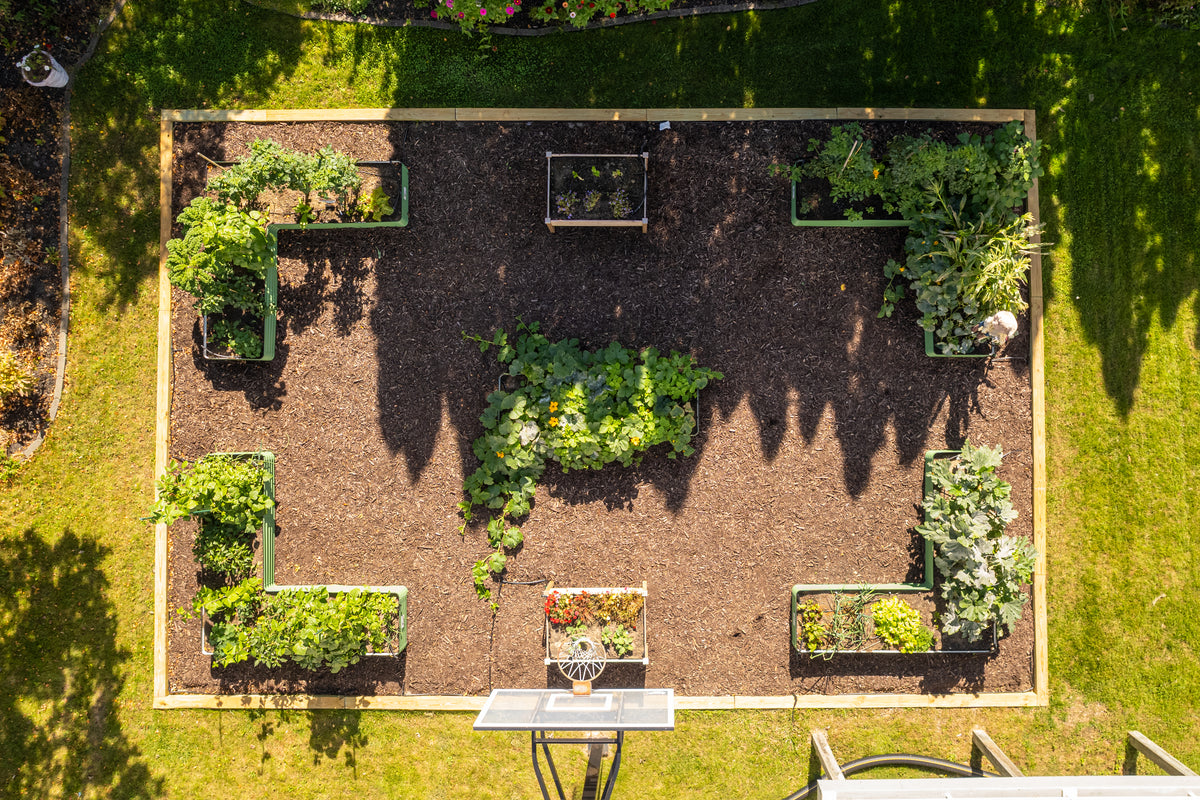
Lay out your beds with BE Garden Match
BE Garden Match lays out your beds square by square, so you can try a layout before you set a single bed. It gives you the dates to plant for your region, totals the soil for each bed and can email your plan with planting reminders.
Shown: BE raised garden beds.
Raised bed garden plans by yard size
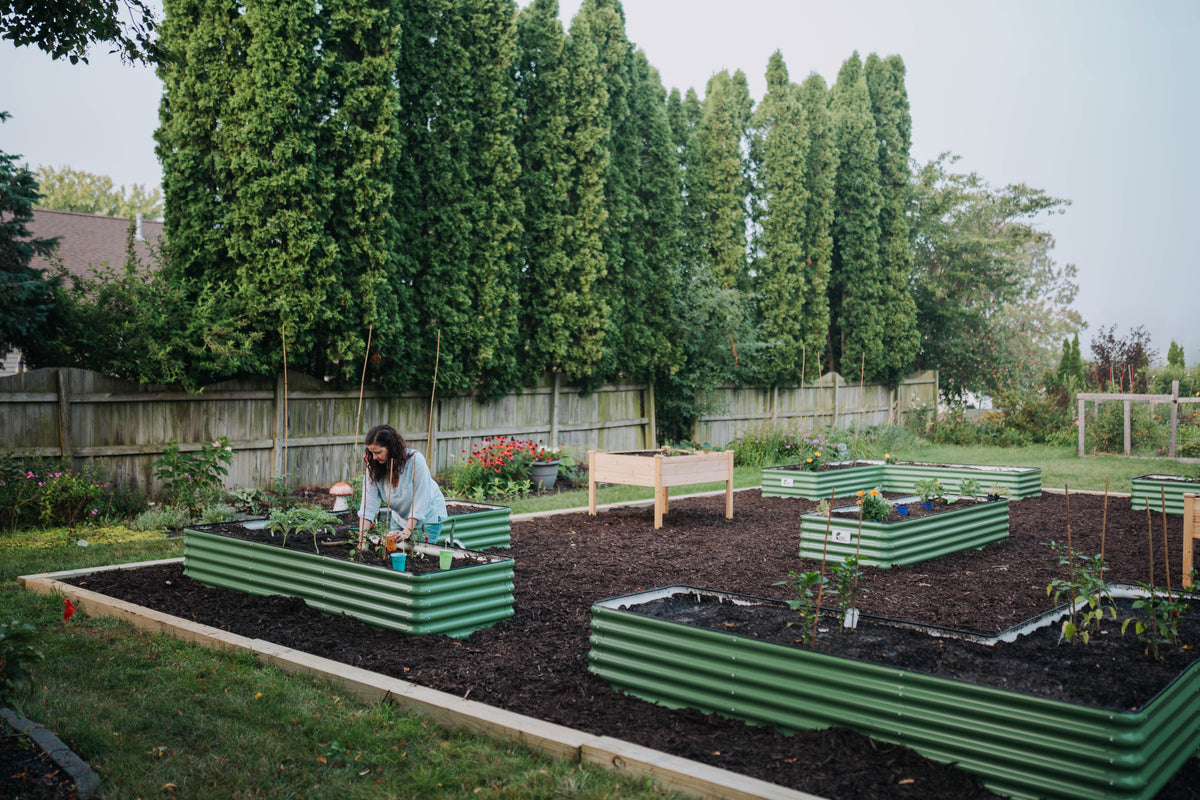
BE makes four shapes, each 18 inches tall and about 30 inches across: the straight Inline (98 by 31 inches), the L-shaped Loam (98 by 98), the T-shaped Tiller (98 by 91) and the U-shaped Union (98 by 68). One Inline needs a strip a little over 8 feet long, plus walking room beside it. From there the beds combine into gardens, and each garden's size below includes its paths.
| Garden | Beds | Space it covers | Squares | Price |
|---|---|---|---|---|
| The Patch | 2 Inline | two beds and the path between them | 32 | $299.99 |
| The Alcove | 2 Loam | about 14 x 14 ft | 52 | $499.99 |
| The Avenue | 1 Tiller, 2 Inline | about 14 x 14 ft | 58 | $519.99 |
| The Haven | 2 Loam, 1 Union | about 14 x 19 ft | 80 | $709.99 |
| The Homestead | 4 Loam, 1 Inline | about 24 x 24 ft | 120 | $1,034.99 |
| The Bounty | 4 Loam, 2 Tiller, 2 Union, 1 Inline | about 19 x 40 ft | 228 | $1,824.99 |
The squares are the one-foot planting squares explained in 1x1 planting. Prices are from November 2026. Three or more beds save 5% to 15%, and a garden can grow later without moving the first beds. All BE beds and gardens are on one page.
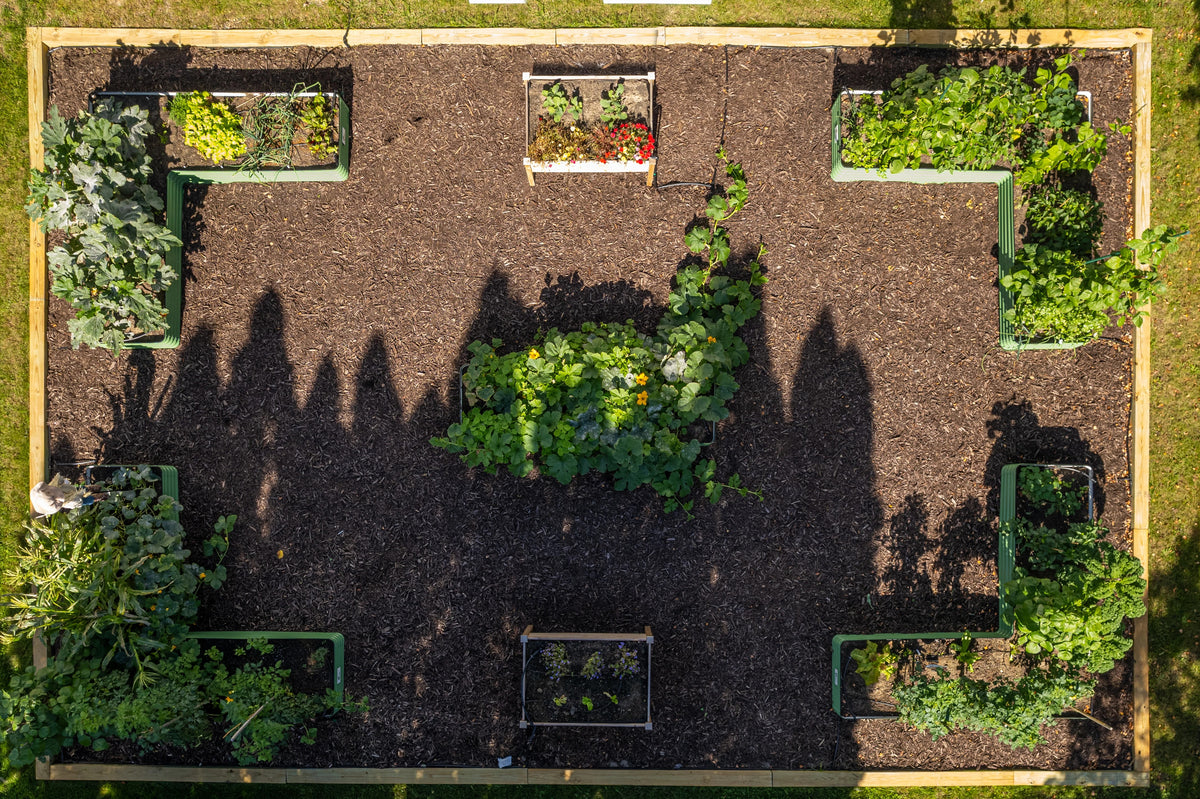
A free raised bed planner: BE Garden Match
- Enter the space. Type the width and the length in feet and inches.
- Look at the gardens that fit. The tool suggests gardens for that space, usually three. Each one shows a drawing to scale, the beds in it and its price, and tags point out the lowest price and the most growing room.
- Load one, or build your own. A tap loads a suggested garden into the 3D view. To start from nothing, drag any of the four bed shapes onto the space, or tap one to drop it in the first open spot. An outline shows green where a bed can sit and red where it cannot, and any bed can be turned or removed.
- Read the summary. Beside the view, the tool lists the beds, the finish (Vine Green or Slate Blue), the true size of the garden with its paths, the planting area, the soil to fill it and the price.
- Plan the planting. The second step asks for a ZIP code and a planting date, then sets the growing zone and region. Pick a ready-made mix or add plants one at a time. The planner places them square by square, with tall plants to the north and each plant family kept to one bed, and it lists what to start indoors and what to sow in the bed.
The design is saved in the browser and in the page link, so the link opens it again. BE Garden Match is free to use, and an email address is only needed to save or send a plan.
After the layout, how much soil a raised bed needs has the figure for each bed, and how deep a raised garden bed should be covers which crops 18 inches suits.
Plan your garden with BE Garden Match
Seasonal tips for your zone
Get a short email when it is time to start seeds, plant and harvest where you live, with what works best in your zone.
Thanks, you are on the list for seasonal tips for your zone.
Unsubscribe anytime.
You may also like
Sources
- Iowa State University Extension and Outreach, Creating Raised Bed Planters, reviewed October 2026
- University of Delaware Cooperative Extension, Raised Bed Gardening, October 2024
- University of Minnesota Extension, Raised bed gardens, reviewed 2026
- Oklahoma State University Extension, Raised Bed Gardening
- University of Georgia Extension, Circular 1027-4, Raised Garden Bed Dimensions, December 2022
- BE Green Living, raised garden beds and gardens and BE Garden Match: bed sizes, garden sizes, squares and prices, November 2026